
When comparing AI phone systems for restaurants, true 99.9% uptime means a maximum of 43 minutes downtime monthly, though leading providers like Google Cloud guarantee 99.99% (just 4 minutes). Hostie AI leverages this enterprise infrastructure alongside Twilio's redundant network to maintain reliability, while competitors using OpenAI APIs face vulnerabilities from provider outages lasting 15+ hours.
• AI phone systems reduce missed calls by 87% and hold times by 91% compared to human hosts, but only when operational
• Restaurant AI generates $3,000-$18,000 monthly revenue per location through captured reservations and upselling
• Restaurants average 187 daily calls, yet only 30% have systems capable of effectively handling them
• Native Toast POS integration enables zero-touch reservations and 26% lift in covers when properly configured
• OpenAI experienced major outages in 2025 affecting dependent voice AI services, including a 15-hour incident impacting two dinner services
• Financial SLA credits range from 10-50% of monthly bills but don't recover lost reservation revenue
Restaurant owners know the pain of a silent phone line during dinner rush. When your AI phone system goes down, so do your reservations. That's why 99.9% uptime isn't just a nice number on a spec sheet—it's the difference between a packed dining room and empty tables. In this guide, we'll break down what uptime really means for your business and compare how Hostie AI stacks up against competitors like Slang AI when it comes to keeping your phones answered.
Picture this: it's Friday at 6 PM, and your phone system hiccups for just a few minutes. In that window, a dozen callers hear nothing but dead air. Over two-thirds of Americans would ditch restaurants that don't answer the phone. That's not a minor inconvenience—it's revenue walking out the door.
The math is brutal. In-demand restaurants receive 800–1,000 calls monthly, with many averaging 187 calls daily. Yet only 30% have systems capable of effectively answering or routing those calls. When AI handles the phones reliably, the results speak for themselves: an 87% reduction in missed calls and a 91% drop in hold time compared to live hosts during peak hours.
But here's the catch: those gains evaporate the moment your system goes offline. When OpenAI's ChatGPT experienced a daylong outage affecting services globally, any voice AI built on that infrastructure left restaurants stranded. For a busy establishment, even a few hours of downtime during service can mean hundreds of lost covers.
Key takeaway: Uptime isn't a backend concern—it's the foundation of every reservation your AI books.

Service Level Agreements (SLAs) promise uptime in percentages, but what do those numbers actually mean for your phone lines? Let's translate:
| Uptime Percentage | Maximum Monthly Downtime | Risk Level for Restaurants |
|---|---|---|
| 99.99% | ~4 minutes | Minimal |
| 99.95% | ~22 minutes | Low |
| 99.9% | ~43 minutes | Moderate |
| 99.5% | ~3.6 hours | High |
| 99.0% | ~7.3 hours | Severe |
Google Cloud's Compute Engine guarantees 99.99% uptime, with service credits if they fall short. At that level, you're looking at roughly four minutes of potential downtime per month. Drop to 99.5%, and you're risking over three hours—potentially an entire dinner service.
When providers miss their targets, the best SLAs offer financial credits as compensation. Google's tiered system, for example, offers 10% credit for 99.00–99.95% uptime, scaling up to 50% of your monthly bill if uptime falls below 95%. But let's be honest: a billing credit doesn't bring back the guests who hung up.
Twilio, the telephony backbone many AI systems rely on, commits to 99.99% uptime for customers through geographically distributed infrastructure. When evaluating any AI phone system, ask what their SLA actually guarantees and what happens when they miss it.
Hostie AI was built from the ground up for restaurants, and that includes the infrastructure. By layering Google Cloud's 99.99% infrastructure with Twilio's globally redundant network, Hostie delivers the kind of reliability that keeps phones ringing and answered during your busiest hours.
The proof is in the numbers. When Flour + Water, a San Francisco restaurant, went live with Hostie, the results surprised even the team behind it. As Amanda Flores, their director of operations, shared:
"We learned were getting up to 1,000 calls per week. Everyone, including Hostie, was surprised at the actual volume of requests we were getting. And we immediately started tweaking the service to make sure people were getting answers. Just four weeks in, we had over 1,300 phone calls resolved through AI."
That's not just call volume—it's call resolution, meaning guests got answers without the system dropping or failing over. Twilio's infrastructure, which Hostie relies on, is deployed across multiple AWS regions to ensure redundancy. The company invests millions in AI and machine learning to proactively identify issues before they become outages.
For restaurateurs, this translates to confidence. When your phones are the front door to your dining room, you need a system that doesn't take breaks.
No AI system is immune to hiccups, but the frequency and severity of outages matter. Slang AI, a voice AI platform focused on restaurants, has gained traction in New York and Las Vegas. However, its reliance on large language model (LLM) providers like OpenAI introduces a structural vulnerability.
In June 2025, OpenAI's ChatGPT experienced issues starting around 3AM ET, with multiple regions impacted globally. The outage affected ChatGPT, the Sora text-to-video tool, and OpenAI APIs. For any voice AI dependent on those APIs, calls simply stopped working. A month earlier, the tool experienced a 15-hour outage—that's nearly two full dinner services gone.
Slang AI's approach also exposes limitations when calls get complicated. As one restaurant operator noted, "Sometimes questions are more complicated than what our AI agent can handle like asking about parking or allergies or special needs." When the system can't resolve a call, it needs to escalate—but if the underlying infrastructure is down, there's nowhere to escalate to.
Disconnected systems compound the problem. Research shows businesses waste 286 hours per year switching between disconnected systems, roughly 36 working days. For restaurants, that fragmentation means more points of failure and slower recovery when something goes wrong.
Key takeaway: Uptime depends on every link in the chain, from the LLM to the telephony layer to the integration with your POS.
Reliability isn't just about avoiding disaster—it's about capturing revenue you'd otherwise lose. Let's put some numbers to it.
AI hosts are generating an additional $3,000 to $18,000 per month per location, up to 25 times the cost of the AI host itself. That's revenue from reservations that would have gone to voicemail, upsells that would have been missed, and walk-ins who would have called ahead but got no answer.
During peak hours, AI assistants achieved a 23.7% upsell success rate compared to 18.9% for human hosts. That's a measurable lift, but only if the phone is answered in the first place.
Consider the cost of Slang AI, which runs about $450 per month per location. If downtime costs you even a handful of reservations, the math quickly tips negative. Hostie's Basic plan starts at $199 per month per location, and restaurants using it report measurable ROI fast: more reservations booked, more walk-ins captured, and fewer missed calls.
| Metric | AI Hosts | Human Hosts |
|---|---|---|
| Missed Calls (Peak Hours) | 87% fewer | Baseline |
| Hold Time | 91% shorter | Baseline |
| Upsell Success Rate | 23.7% | 18.9% |
| Monthly Revenue Lift | $3,000–$18,000 | Varies |
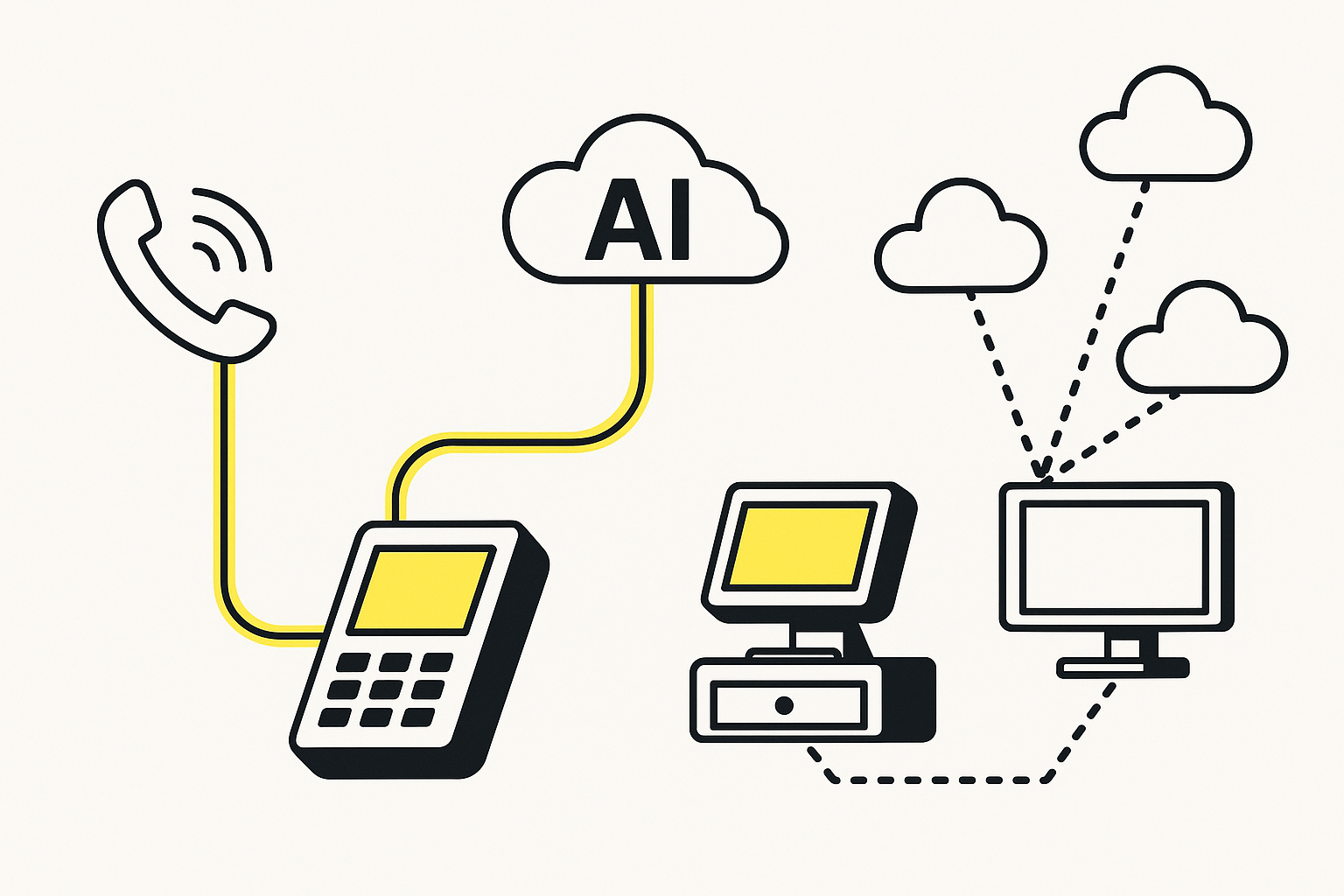
Deep integration with your POS isn't just a convenience—it's a resilience strategy. When your AI phone system talks directly to Toast, you reduce the number of failure points between a caller's request and a ticket in the kitchen.
Hostie AI offers seamless integration with Toast POS systems, allowing for real-time order processing and synchronization. Toast's new Voice Ordering beta, released in June 2025, enables zero-touch reservations where calls flow directly from AI systems to restaurant POS and kitchen display systems without human intervention.
The setup process is faster than most expect. With proper preparation, you can have your AI voice agent handling calls and syncing orders in under 30 minutes. Here's a quick overview of the steps:
AWS's guidance for restaurant contact centers emphasizes the value of integrating POS, CRM, and loyalty programs into a single environment. Serverless components like Amazon Connect and Amazon Lex are highly available and scale automatically, reducing the risk of bottlenecks during peak periods.
Restaurants implementing AI reservation systems with native Toast integration are seeing an average 26% lift in covers. That's the payoff of fewer handoffs, fewer errors, and fewer chances for something to break.
When it comes to AI phone systems, uptime is the feature that makes every other feature possible. Missed calls don't just annoy guests—they cost you real money, every single day.
Hostie AI's approach, layering enterprise-grade cloud and telephony infrastructure with restaurant-specific logic, delivers the kind of reliability that lets you focus on hospitality, not IT fires. Restaurants using Hostie report measurable ROI fast: more reservations booked, more walk-ins captured, and fewer missed calls.
If you're evaluating AI phone systems for your restaurant, ask the hard questions about uptime, SLAs, and what happens when the underlying LLM provider goes down. The best systems are built to keep your phones and your business running, no matter what.
💡 Ready to see Hostie in action?
Don't miss another reservation or guest call.
👉 Book a demo with Hostie today
99.9% uptime means your AI phone system is operational for all but about 43 minutes per month. This level of reliability is crucial for restaurants to avoid missed reservations and lost revenue.
Hostie AI leverages Google Cloud's 99.99% infrastructure and Twilio's globally redundant network to ensure high uptime. This combination provides a robust and reliable system that minimizes downtime during peak hours.
Downtime can lead to missed reservations and lost revenue. AI hosts can generate an additional $3,000 to $18,000 per month per location, making uptime critical for maximizing revenue.
Hostie AI offers more reliable uptime by using a robust infrastructure, while Slang AI's reliance on large language model providers like OpenAI can introduce vulnerabilities, as seen in recent outages.
Integration with Toast POS systems allows for real-time order processing and synchronization, reducing failure points and increasing efficiency. This integration can lead to a 26% lift in covers for restaurants.
RELATED