
Multilingual AI hosting replaces traditional call centers with voice agents that handle restaurant calls in 20+ languages, answering within one ring 24/7. Studies show AI reduces missed calls by 87% while generating $3,000-$18,000 additional monthly revenue per location through consistent availability and upselling.
• Cost savings: AI hosts cost $199-499/month versus $6,086 for human hosts, delivering 700-1,700% ROI within 6-12 months
• Revenue impact: 43% of restaurant calls go unanswered, costing venues up to $292,000 annually in lost business
• Performance metrics: AI achieves 91% reduction in hold times and 23.7% upsell success rate versus 18.9% for humans
• Language support: Modern AI hosts handle 20+ languages compared to 1-2 for traditional staffing
• Integration speed: Systems connect with OpenTable and Square POS in under 60 minutes
• Market growth: Food automation sector expected to reach $14 billion by end of 2024
Picture this: It's a Friday night, your dining room is buzzing, and the phone won't stop ringing. Your host is torn between greeting the couple at the door and answering yet another call about your hours. Meanwhile, three callers have already hung up and are now making reservations at your competitor down the street.
Sound familiar? You're not alone. Research shows that 43% of restaurant phone calls go unanswered, costing the average venue up to $292,000 annually in lost business. And with 63% of Americans preferring to call restaurants directly, that ringing phone represents real revenue walking out the door.
The good news? 2025 is the year you can finally hang up on that problem. Multilingual AI hosting lets restaurants greet every caller in their own language, 24/7, while slashing payroll. Whether your guest speaks English, Spanish, Mandarin, or any of 20+ languages, a friendly AI host can handle their call within one ring.
Let's explore how this technology works, what it costs, and how you can roll it out in your restaurant.
Multilingual AI hosting is a cloud service that replaces a human-staffed call center with voice agents capable of understanding and responding in 20+ languages.
Unlike the robotic phone trees of yesterday, today's AI phone systems can handle calls, texts, emails, reservations, and orders 24/7, integrating seamlessly with major reservation systems and POS platforms. Using real-time speech recognition, translation, and natural-language generation, the AI answers every call within one ring, books reservations, handles orders, and even upsells.
New AI technologies are revolutionizing customer-facing functions. Companies like Newo.ai, Slang, RestoHost, and Hostie are not just managing bookings; they're engaging in natural conversations, handling multiple languages, and showcasing soft skills previously thought to be exclusive to humans.
The purpose of these task-oriented dialogue systems is straightforward: to allow users to complete a concrete task through conversational interaction with the system. For restaurants, that means booking a table, placing a takeout order, or getting answers about dietary accommodations without ever putting a guest on hold.
The math simply doesn't work for traditional phone coverage.
In-demand establishments receive between 800 and 1,000 calls per month, yet only 30% have systems capable of answering or routing calls effectively. The result? Lost revenue and frustrated guests.
Here's where traditional call centers fall short:
The bottom line: missed calls translate directly to missed revenue that your competitors are happy to capture.
The benefits of AI hosting extend far beyond just answering the phone. Here are seven concrete wins restaurants are experiencing:
Key takeaway: The combination of captured revenue and labor savings means most restaurants see 700-1,700% ROI within 6-12 months.
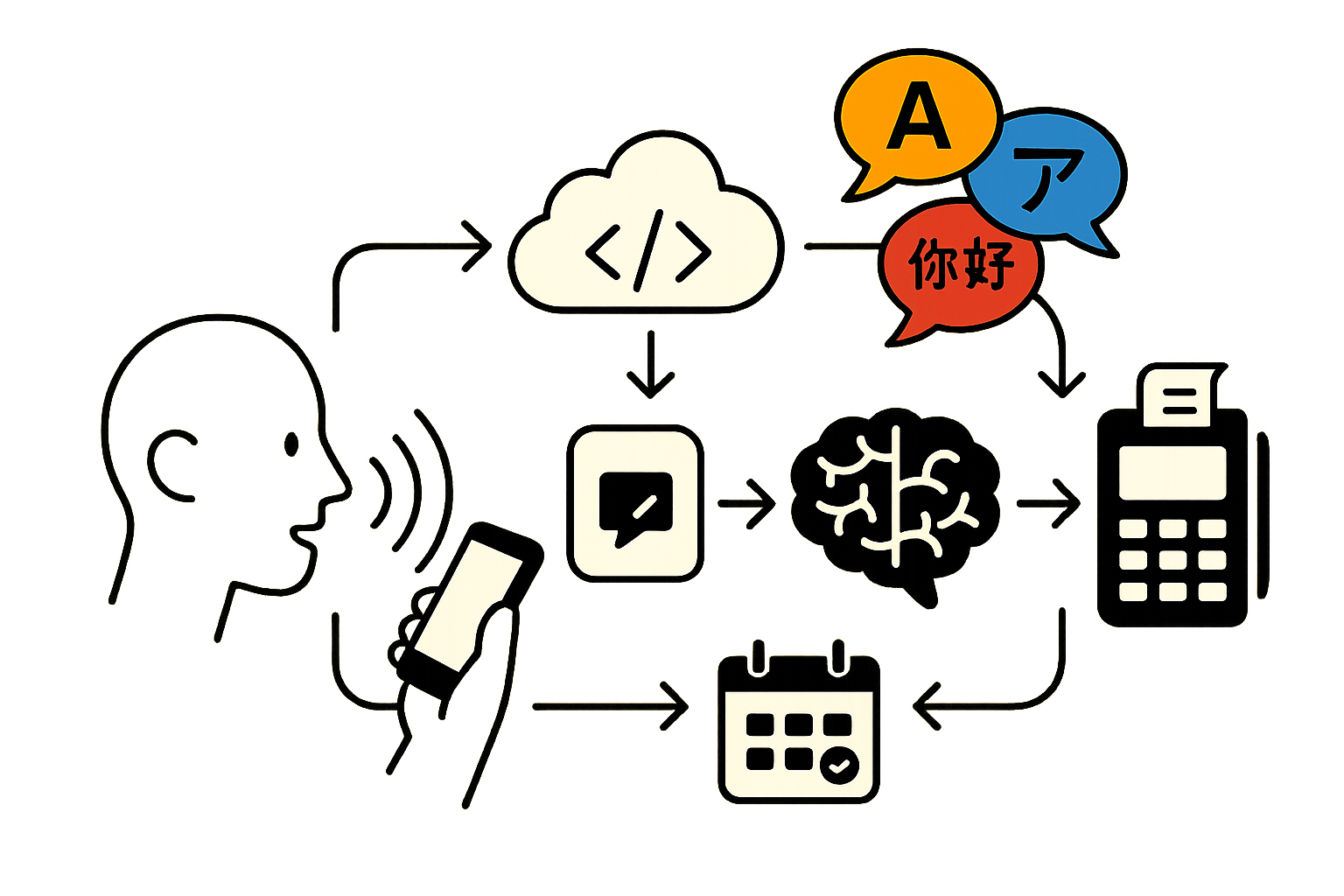
Understanding the technology helps you evaluate options and set realistic expectations.
A conversation with a voice agent is generally organized in three phases: opening activity, main sequence, and closing activity. The AI greets the caller, handles their request through natural dialogue, and wraps up with confirmation or next steps.
A typical voice-to-voice system involves multiple steps: customer speech recognition, translation, replay of translated text, information retrieval, agent spoken utterances, and text-to-speech conversion. Modern systems process these steps in milliseconds.
The magic happens through direct integration with your existing systems. AI hosts sync third-party platforms like your CRM or POS for real-time reservations, guest info, order details, and more.
The speech pipeline is where AI voice agents truly shine.
Real-time voice agents prioritize sub-300 ms latency, which approaches the natural cadence of human conversation. This speed is critical; unlike text-based chatbots, voice interactions feel unnatural if there's too much delay.
The best voice agents follow design principles that make conversations feel natural. Alexa's warmth, friendliness, and personalized touches makes each interaction enjoyable. Similarly, well-designed restaurant AI hosts balance efficiency with hospitality.
Google's voice agent design guidelines emphasize that speech, unlike writing, is inextricably bound to the passage of time. The longer someone holds the floor, the more brainwork they're imposing on the listener. That's why effective AI hosts keep responses brief and relevant.
Integration is simpler than you might expect. Here's what the setup process typically looks like:
Let's look at the numbers that matter most to restaurant operators.
| Metric | Human Host | AI Host | Impact |
|---|---|---|---|
| Monthly cost | $6,086 | $199-$499 | 85-95% savings |
| Call answer rate | 65-75% | 95%+ | Revenue capture |
| Languages supported | 1-2 | 20+ | Market expansion |
| Availability | Limited hours | 24/7 | Never miss a call |
Real-world results speak volumes:
As Amanda Flores, Director of Operations at Flour + Water, shared: "We didn't want our guests to suffer more from speaking to a robot. We pushed off the decision for a while... but just four weeks in, we had over 1,300 phone calls resolved through AI."
Choosing the right AI host depends on your restaurant's priorities. Here's how the leading platforms compare:
Hostie AI positions itself as "AI for restaurants, made by restaurants," emphasizing its restaurant-operator origins. Hostie AI emerges as the clear choice for upscale restaurants that prioritize guest experience sophistication and operational flexibility. Key strengths include 20+ language support, deep POS integration, and real-time conversation monitoring.
Slang.ai focuses on rapid deployment and conversion metrics. The platform claims to drive up to 50% more phone covers and can be implemented in as little as 30 minutes. One user reported caller satisfaction at 96% for the last 90 days.
Maple Voice targets high-volume restaurants where phone orders drive revenue. At $120 per month for the base plan, it offers competitive pricing with optional modules for orders ($80/month) and bookings ($80/month).
The bottom line: For fine dining and upscale casual restaurants where guest experience is paramount, Hostie AI offers the deepest customization and hospitality focus. For high-volume operations prioritizing speed and conversion, the other platforms may suffice.
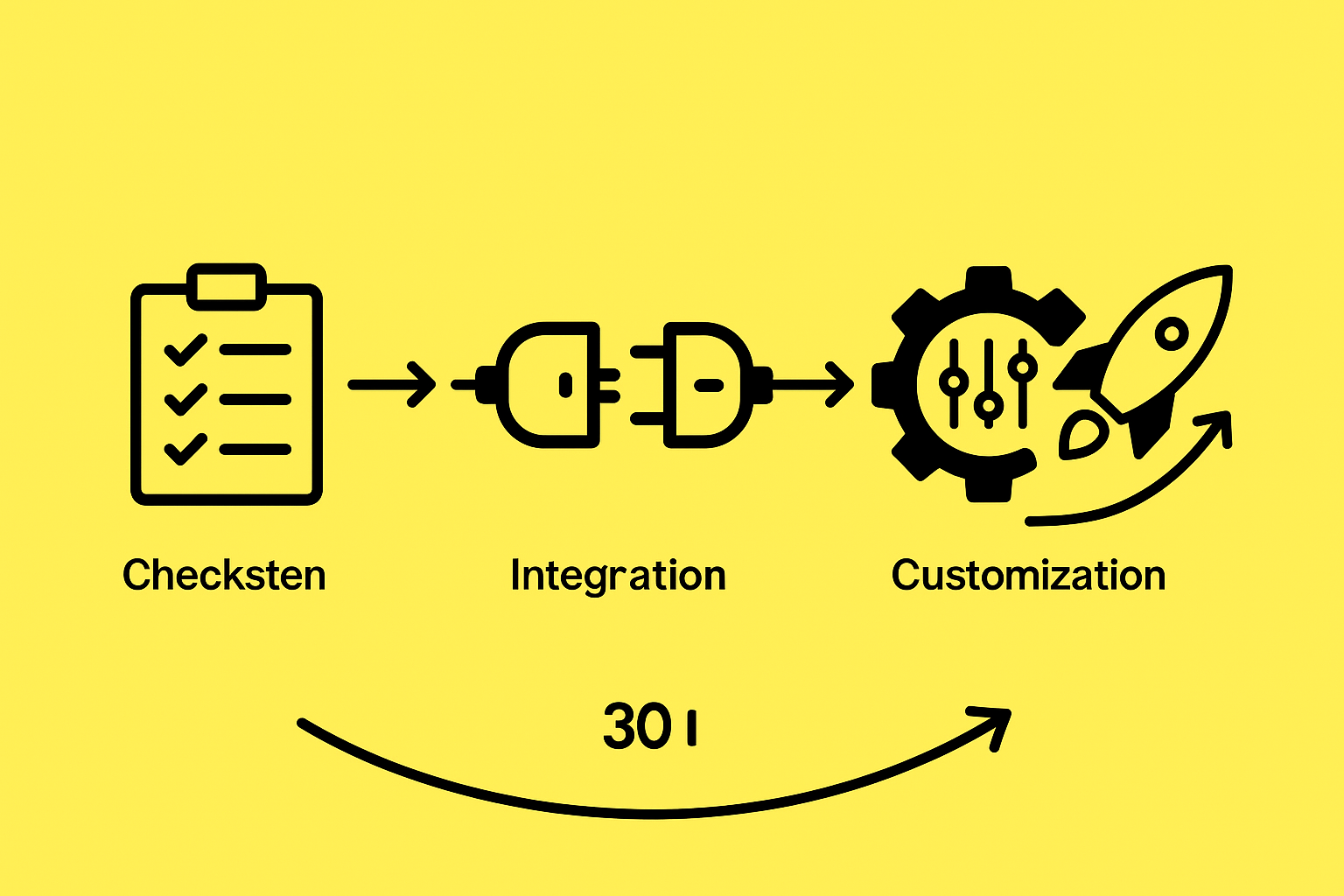
Ready to make the switch? Here's your practical deployment roadmap:
Week 1: Assessment and Selection
Week 2: Integration Setup
Week 3: Customization and Training
Week 4: Launch and Monitor
Every technology has challenges. Here's how to address the most common concerns with AI hosting:
Latency Management
Today's technology cannot eliminate inherent latency. However, there are multiple strategies to optimize system design and reduce its perceptible impact. Best practices include:
Privacy and Data Security
For restaurants handling any sensitive information, 98% of contact center leaders say they're already using AI in some capacity, demonstrating industry confidence in the technology. Key safeguards include:
Learning from Industry Setbacks
Not every AI implementation succeeds. McDonald's ended its drive-thru AI test with IBM after challenges with accuracy and customer experience. The lesson? Generative AI is set to redefine the contact center landscape, but implementation matters as much as technology selection.
Quality Assurance
Modern conversation intelligence solutions let you analyze contact center conversations, score interaction quality automatically, and support employees with AI. Use these tools to continuously improve your AI host's performance.
The restaurant industry is at an inflection point. Voice AI technology has matured to the point where it can genuinely enhance hospitality rather than diminish it.
As one industry observer noted, Jasmine the AI voice host is a member of a new, growing clan. These AI hosts are proving that technology and hospitality can work together to create better guest experiences.
The numbers are compelling: 87% fewer missed calls, 91% reduction in hold times, and revenue increases of $3,000 to $18,000 per month per location. More importantly, your staff gets to focus on what they do best: creating memorable in-person experiences for your guests.
For restaurants ready to stop losing calls and start capturing every opportunity, multilingual AI hosting isn't just the future. It's available today.
💡 Ready to see Hostie in action?
Don't miss another reservation or guest call.
👉 Book a demo with Hostie today
Multilingual AI hosting is a cloud service that replaces human-staffed call centers with AI voice agents capable of understanding and responding in over 20 languages, handling calls, texts, emails, reservations, and orders 24/7.
AI hosting reduces missed calls, increases revenue through upselling, provides 24/7 availability, and supports multiple languages, allowing staff to focus on in-person hospitality and expanding market reach.
AI hosts offer significant cost savings, with monthly costs ranging from $199 to $499 compared to $6,086 for human hosts, while also providing higher call answer rates and supporting more languages.
AI hosting integrates with reservation systems like OpenTable and POS platforms such as Toast and Square, enabling real-time data synchronization for reservations, orders, and menu updates.
Restaurants can see a 700-1,700% ROI within 6-12 months due to increased revenue capture, labor savings, and enhanced guest experience, with some seeing payback in as little as four weeks.
RELATED