
When evaluating an AI host with real-time transcripts for your restaurant, superior monitoring capabilities make the difference between compliance success and costly violations. Modern AI hosts must meet PCI DSS v4.0.1 requirements by March 31, 2025, handle TCPA regulations for AI-generated voices, and provide transparent call transcripts for audit trails while maintaining transcription accuracy rates above 90% for compliance verification.
When your restaurant adopts an AI host with real-time transcripts, one missed compliance box can cost you more than a bad review. With TCPA violations reaching $500 to $1,500 per call and PCI fines climbing as high as $100,000 per month, the stakes have never been higher for restaurants embracing voice AI technology.
This guide breaks down exactly what compliance features you should demand from any AI phone host, how the leading solutions stack up, and why superior monitoring can make the difference between growth and costly penalties.
Restaurants are rapidly embracing AI-powered phone systems, with the Voice AI market projected to expand from $10 billion to $49 billion by 2029. But this growth comes with serious responsibility.
Consider this: 63% of Americans say calling is their preferred way to contact a restaurant, and 69% will give up on dining somewhere if no one answers. That phone line is your lifeline to revenue, but it's also where sensitive payment data and personal information flow freely.
PCI DSS v4.0.1 now explicitly requires that sensitive authentication data be rendered unrecoverable after authorization. For AI phone systems, this means specific mandates around CVV audio suppression, card tokenization, and call recording purging.
The financial upside is substantial when done right. AI hosts are generating additional revenue of $3,000 to $18,000 per month per location, but only if you protect that revenue stream with proper compliance measures.
Key takeaway: Compliance isn't just about avoiding fines. It's about protecting the revenue your AI host generates and maintaining the customer trust that keeps guests calling back.

Four major regulatory frameworks apply to restaurant AI phone systems. Understanding each helps you evaluate vendors and protect your business.
PCI DSS (Payment Card Industry Data Security Standard)
"The Payment Card Industry Data Security Standard represents a security checklist created by major credit card companies to ensure businesses keep credit card data safe from theft." Voice AI systems handling payment data must address data storage limitations, encryption requirements, access controls, and network security.
TCPA (Telephone Consumer Protection Act)
The FCC issued a declaratory ruling in February 2024 confirming that AI-generated voices fall under the TCPA. This means your AI host must obtain express consent before making AI-generated calls and comply with restrictions on call times and content.
SOC 2
SOC 2 compliance is based on the Trust Services Criteria, with the most common being Security, Availability, and Confidentiality. These standards ensure your AI vendor maintains enterprise-grade security controls.
HIPAA
While most restaurants don't handle protected health information, dietary restrictions and allergy data can create compliance considerations. Having HIPAA-style encryption future-proofs your operation.
Mark these dates and numbers on your calendar:
Transcription accuracy isn't a nice-to-have feature. It's foundational to compliance monitoring.
When auditors review your call records, they need to verify exactly what was said. A mis-heard card digit or garbled opt-out request creates liability. The industry standard for measuring speech recognition accuracy is Word Error Rate (WER), and for compliance purposes, you want that number as low as possible.
Modern speech recognition systems achieve over 90% accuracy in optimal conditions, but real-world restaurant environments include background noise, accents, and overlapping speech. That's why independent testing matters more than marketing claims.
8x8 outperformed Dialpad and RingCentral by over 50% in transcription accuracy, demonstrating that clean inputs fuel everything downstream, from insights to automation to compliance verification.
| Provider | Word Error Rate | Price per Hour | Best For |
|---|---|---|---|
| 8×8 | 3.43% | Enterprise pricing | Compliance-critical environments |
| Salad Transcription API | Market-leading | $0.16 | Cost-conscious accuracy |
| Lingvanex | 10.98% (multilingual) | Variable | European language support |
| WhisperX | 88-93% on clean benchmarks | $0.15/minute | Professional transcription |
The Tolly Group conducted independent testing in February 2025 using real-world voice samples across diverse accents and speakers. Their findings showed 8×8's word error rate at 3.43%, while competitors exceeded 8%.
For restaurants serving diverse communities, multilingual accuracy matters too. Lingvanex consistently delivered the lowest error rates in English, German, and Spanish, three of the most commonly used business languages.
Call recordings are compliance gold and liability dynamite. Handle them correctly with these practices.
Retention policies matter. New and existing privacy regulations require that personal information be retained only as long as necessary for legitimate business needs. In 2022, the French Data Protection Authority imposed a €250,000 fine on an organization for keeping data longer than the purpose required.
Platform-controlled recording. Recordings must be made on the provider's platform, with distribution links provided after calls and automatic deletion after defined periods, typically 60 days.
Real-time dashboards for monitoring. Real-time dashboards are transforming hospitality management by providing live updates on operations, guest satisfaction, and revenue. Modern dashboards integrate cloud computing, APIs, and AI to deliver actionable insights with predictive analytics, automated alerts, and mobile access.
Encryption and access controls. A robust call recording solution should offer features that support compliance, such as encryption at rest and in transit, role-based permissions, and multifactor authentication.
Automatic redaction. PCI standards require specific handling of any recordings that might contain sensitive data. Look for AI-powered solutions that automatically identify and redact credit card information from recorded customer interactions.
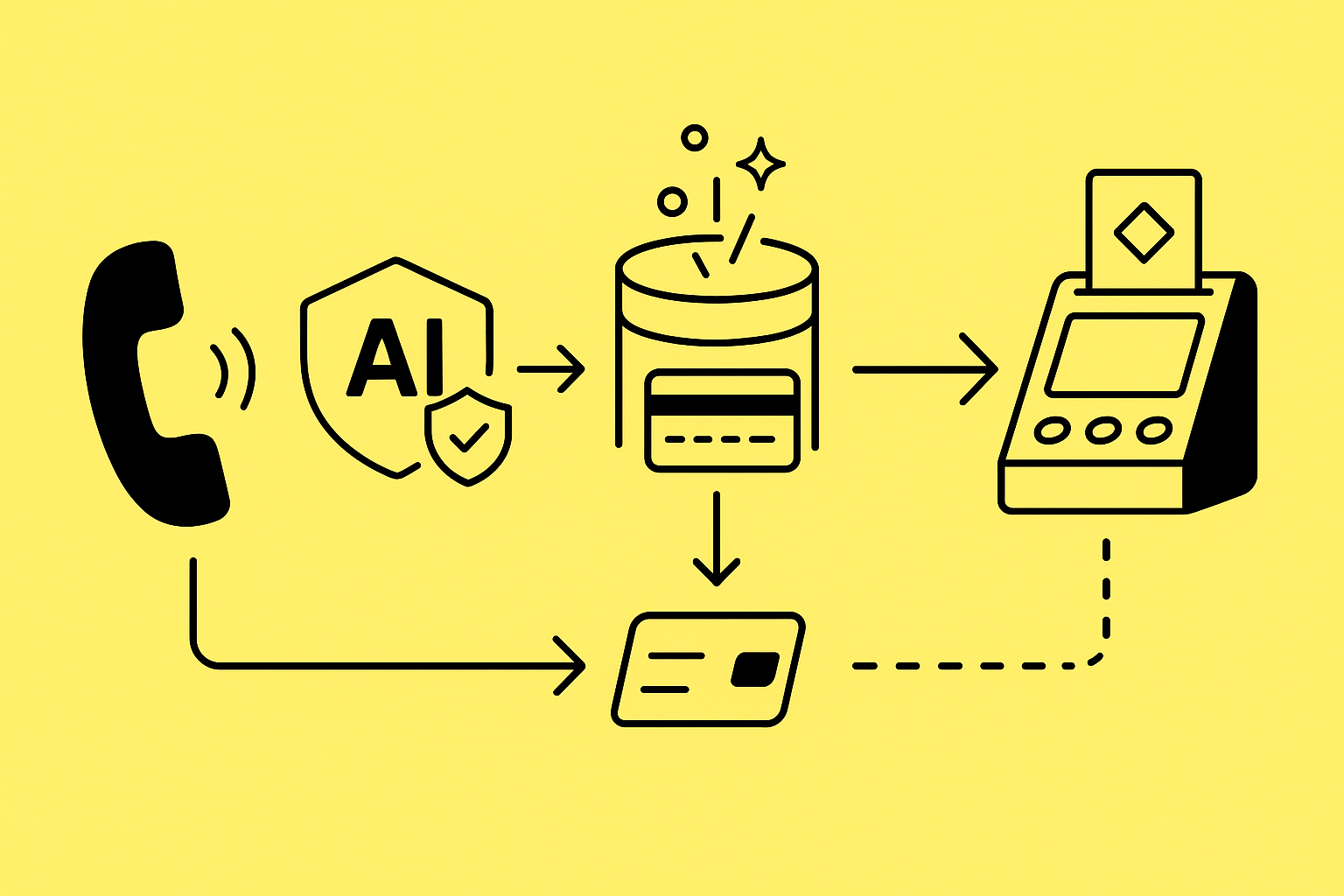
Tokenization represents the gold standard for protecting payment data in voice AI systems. Here's how it works and why Hostie's approach stands apart.
When a guest reads their card number over the phone, a tokenization system immediately replaces that sensitive data with a non-sensitive token. The original card number never touches your restaurant's systems, dramatically reducing your PCI compliance scope and liability.
Hostie integrates with major platforms across reservations, POS, ordering, and guest management including OpenTable, Resy, Toast, Square, and more. This deep integration means payment data flows securely through established, compliant channels rather than homebrew solutions.
With 70% of restaurant transactions now made via cards, ensuring PCI compliance isn't optional. The updated PCI DSS 4.0 standards introduce specific mandates for AI-driven payment environments, particularly around CVV audio suppression and card tokenization.
What separates Hostie from competitors comes down to three core advantages:
Burma Food Group, with over 20 years in the restaurant industry, faced a common challenge: phone lines ringing off the hook during service while guests waited in front of the host stand.
After implementing Hostie at their newest location, Teakwood, the results spoke for themselves: over-the-phone bookings nearly tripled.
General Manager Bianca Decker shared her experience: "It's definitely improved my day-to-day. I love not having to hear the phone ringing when we're in the middle of dinner service when I have a line of guests in front of me."
The compliance piece was equally important. Call recording solutions are a valuable tool for companies aiming to improve customer service, document interactions, and ensure legal and regulatory compliance. With Hostie's transparent transcripts and integrated compliance features, Burma Food Group maintained full visibility into every guest interaction.
Operations Manager Chris Tan highlighted the local support advantage: "Speaking with Hostie and with Randall, we felt the connection that we thought would work in terms of personality fit. They're local and they were able to answer all of our questions."
Before signing with any AI phone host provider, get clear answers to these questions:
Non-compliance with PCI standards can lead to fines of up to $100,000 per month, legal issues, and significant loss of customer trust. These questions help you avoid that outcome.
One partner saw a 13% lift in reservations within the first month; another nearly tripled over-the-phone bookings. Those results came from an AI host built with compliance at its core.
With advanced AI-driven analytics and automated transcription, companies can extract valuable insights from their calls to enhance customer satisfaction, streamline operations, and ensure security compliance.
Hostie was designed for restaurants that take both hospitality and compliance seriously. Every call gets answered, every transcript gets saved, and every payment interaction stays secure.
💡 Ready to see Hostie in action?
Hostie was designed to offer the best automated guest management system that learns and engages with nuance. That includes understanding the compliance landscape so you don't have to become a regulations expert.
With unlimited call handling, transparent transcripts, and deep integrations with the payment and reservation platforms you already use, Hostie takes the compliance burden off your plate while delivering the guest experience your restaurant deserves.
"Speaking with Hostie and with Randall, we felt the connection that we thought would work in terms of personality fit. They're local and they were able to answer all of our questions," said Chris Tan of Burma Food Group.
The future of restaurant phone service is AI-powered, compliant by design, and already helping restaurants across New York, Los Angeles, San Francisco, and beyond capture more reservations while sleeping soundly at night.
AI phone hosts must comply with regulations like PCI DSS, TCPA, HIPAA, and SOC 2. Key features include CVV audio suppression, card tokenization, and call recording purging to protect sensitive data and ensure legal compliance.
Hostie uses tokenization to replace sensitive card data with non-sensitive tokens, reducing PCI compliance scope and liability. It integrates with major platforms like OpenTable and Toast, ensuring secure payment data flow.
Transcription accuracy is crucial for compliance audits, as it ensures that call records accurately reflect customer interactions. High accuracy reduces liability from misheard information, with industry standards aiming for low Word Error Rates.
Hostie implements platform-controlled recording with automatic deletion after defined periods, encryption, and access controls. It also uses AI-powered solutions for automatic redaction of sensitive data from recordings.
Non-compliance can lead to significant fines, such as up to $100,000 per month for PCI violations and $500 to $1,500 per TCPA violation. These penalties highlight the importance of maintaining compliance to protect revenue and customer trust.
RELATED